Pulsar
A tiny arcade orbit shooter — a complete, deployable game generated from a single zero-shot prompt to a fully self-hosted LLM.
About the Game
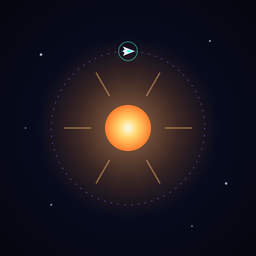
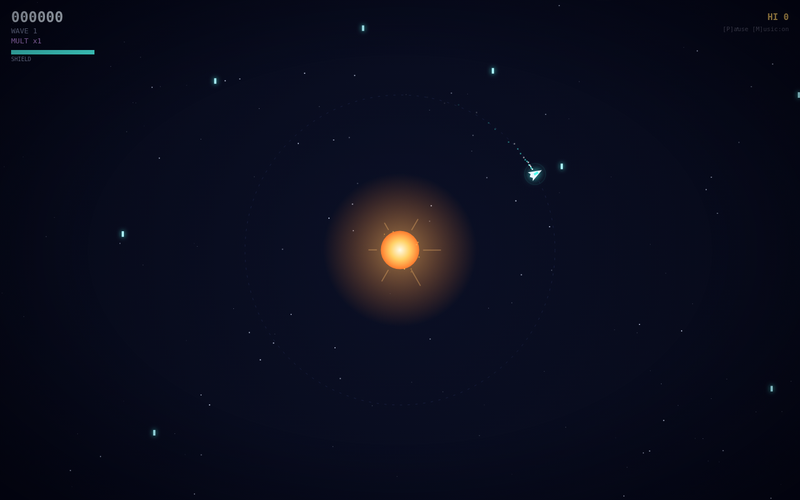
The star is dying. You are the only thing orbiting it — hold the line. Pulsar is a single-screen arcade shooter in which your ship rides a fixed orbit around a pulsing star. You can't fly inward or outward; you can only steer around the ring and fire. Everything else falls toward the star, and the star is the thing you're defending.
Debris, homing seekers, and closing rings with a single safe gap all converge on the center. Your shield absorbs two hits and regenerates slowly; waves escalate roughly every 1200 points. The whole experience — gameplay, difficulty curve, particle effects, screen shake, and a generative music loop — fits in a single HTML file.
One prompt. No examples. No scaffolding.
Pulsar was not written. It was asked for — a zero-shot prompt, with no examples, no specs, and no code scaffolding. The entire instruction was a single line:
The model was Qwen3.8-27B, running entirely on our own self-hosted server — no external API, no cloud. The output was a working, deployable game: playable on first load, with a complete ruleset, escalating waves, pickups, screen shake, synthesized sound effects, and generative music, all from that single line.
We considered it a success the moment it shipped: the same Docker image and Helm chart pipeline we use for client work took it from generated file to https://demo.carefuldream.com/pulsar without modification.
The Rules of the Void
The star
Your orbit, your shield, your life. If it dies, so do you.
Gold drifters
Lazy rocks falling in — 100 points.
Purple splitters
Big, 3 hits, burst into 3 fast shards — 250 points.
Red seekers
Turn and hunt your ship — 100 points.
Cyan rings
Close in as a circle with one gap: fly through the gap or blast the ring (3 hits) for 300.
White shards
Fast, small, annoying — 25 points.
S pickup
Shield maxed.
R pickup
Overdrive: double fire rate for 5 seconds.
Multiplier pickup
Score multiplier +1, up to x8.
How to Play
- 1Steer around the orbit with A / D or the arrow keys (or by dragging — the ship follows your pointer around the ring)
- 2Hold SPACE or hold mouse / touch to fire; your cannons sweep with the ship
- 3Bank points on debris, thread the gap in incoming cyan rings or shoot them apart, and grab pickups to stack a score multiplier
- 4Manage your shield — it absorbs two hits and regenerates slowly, but no shield plus one touch is a nova
- 5Survive escalating waves. High score is saved locally in your browser.
Under the Hood
One File
The entire game is a single index.html — vanilla JS, no framework, no build step, no dependencies, no network calls, no tracking.
Canvas 2D + rAF
A requestAnimationFrame loop with delta-time updates, device-pixel-ratio scaling, particle systems, and screen shake.
WebAudio Everything
Every sound — lasers, explosions, power-ups, and the game-over sting — is synthesized at runtime, plus a small generative pentatonic music loop.
Boring Deployment
Shipped the way every client app ships: distroless Go static server in Docker, a Helm chart, and our normal CI pipeline. Live at demo.carefuldream.com/pulsar.
Why it matters
This is what self-hosted, small-model code generation looks like when the output is held to production standards. The game shipped through the same Docker, Helm, and CI/CD pipeline we use for enterprise work — generated once, reviewed, and deployed with zero prompt engineering and zero cloud dependence.
The takeaway we take to client work: a self-hosted 27B-parameter model, given one honest instruction, produced a complete, playable, deployable product. The interesting question is no longer whether it can — it's what your "do something interesting" would build.
Have a project like this one?
We'd be glad to talk through your goals, your constraints, and whether we're the right team for the work.